
The Energy Consumption of Artificial Intelligence: A Global Challenge.
A few weeks ago, I had the opportunity to attend a lecture delivered by industrial engineer Mr. Joan Vila, CEO of LC Paper Group and a sustainability expert at the Institut d’Estudis Catalans. In his presentation, Joan Vila structured his talk around three main themes: energy, raw materials, and economic crises. As he highlighted, these three areas are profoundly interconnected and must be addressed to understand our global challenges. During the conference, numerous interesting and relevant topics were discussed, including economics, energy production, CO₂ emissions, and the consumption of raw materials, among others. However, one particular point captivated me and highlighted an issue that society remains largely unaware of, the growing impact of artificial intelligence (AI) on energy consumption and the consequences it could have if not properly regulated.
The Jevons paradox and AI’s energy demand
This topic, far from trivial, can be better understood through a fundamental concept introduced by Joan Vila during the lecture: the Jevons Paradox. This economic theory, formulated in the 19th century by William Stanley Jevons, explains how improvements in resource efficiency, rather than reducing overall consumption, often increase it. The reason for this is that efficiency reduces the cost per unit of use, making the resource more accessible and increasing its demand.
As Joan Vila explained, a classic example of this paradox involves the Industrial Revolution and steam engines. When James Watt improved the efficiency of steam engines, enabling them to use less coal to produce the same amount of energy, the global consumption of coal did not decrease; instead, it significantly increased. Why? Because as efficiency improved, operational costs dropped, making the machines far more accessible and attractive for a broader range of applications. This led to steam engines being used in a much wider variety of industrial and transportation applications, from factories to locomotives. As a result, while each machine consumed less coal individually, the exponential increase in the number of machines in use led to a massive rise in global coal consumption.
What initially appeared to be progress toward reducing energy consumption ultimately resulted in a massive increase in global coal consumption. This phenomenon has been repeated throughout the 20th century and into the present day—not just in energy and energy efficiency but across many sectors of the economy and society. It reminds us that efficiency alone does not always guarantee more rational resource use.
According to Vila, the same dynamic applies to technologies like artificial intelligence. Although AI systems are becoming more efficient, their widespread adoption, combined with Moore’s Law (which predicts that the number of transistors in integrated circuits doubles approximately every two years), drives up the global energy demand associated with these systems. This replicates the pattern observed since the steam engines of the 19th century. Thus, while we might hope that technology would allow us to reduce energy consumption, in reality, it is contributing to a global increase, as we are already witnessing today.
The impact of AI on energy consumption
Artificial intelligence has become one of our most revolutionary and promising technologies, with applications transforming sectors such as medicine, engineering, logistics, e-commerce, education, and many more. However, the operation of these AI systems comes with a high energy cost that often goes unnoticed by the general population but is growing at an alarming rate. Joan Vila emphasized during the conference that energy consumption associated with AI is increasing by 50% annually, an exponential rate far surpassing the energy growth of other technological sectors.
Data centers, the operational heart of AI, are among the main contributors to the energy consumption of this technology. These complex facilities, filled with servers that continuously process operations and generate substantial heat, require not only energy to power the servers but also highly efficient cooling systems. This multiplies their energy consumption. For example, training an advanced AI model can consume as much energy as a hundred households in a year. This reality is particularly concerning when we consider that such training processes are becoming increasingly frequent as AI models grow more sophisticated.
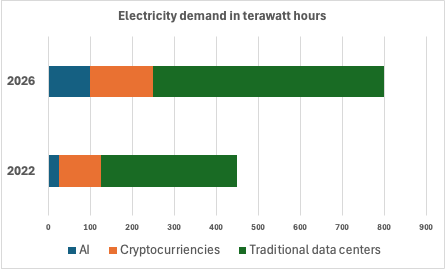
To put AI’s energy consumption in context, the International Energy Agency (IEA) reported that in 2022, traditional data centers consumed around 325 TWh, while AI-specific data centers consumed 25 TWh. By 2026, traditional data centers are expected to increase their consumption to 550 TWh, and AI-specific centers are projected to grow exponentially to 100 TWh, resulting in a total combined consumption of 650 TWh. By 2030, the combined energy consumption of traditional and AI data centers is forecasted to reach around 1,200 TWh. For perspective, this figure is approximately equivalent to the total annual energy consumption of Spain, France, and Germany combined in 2023.
Consequences of uncontrolled growth
This uncontrolled growth has multiple implications. First, it places immense pressure on global energy infrastructures, which are already strained by the demands of other sectors. This could lead to increased reliance on non-renewable energy sources such as coal and gas, hindering global climate goals and raising CO₂ emissions. Furthermore, global inequality would be exacerbated, as countries with weak electrical infrastructures could become technologically marginalized. These inequalities would deepen economic and social disparities and limit access to critical services such as education and healthcare.
Another direct consequence is the climate impact, as AI’s high energy consumption could negate any environmental benefits achieved through process optimization or emissions reductions in other sectors. Finally, this situation poses economic risks, as rising energy costs could make AI inaccessible to many companies and individuals.
Proposed solutions
To address these challenges, Joan Vila proposed a set of solutions aimed at ensuring sustainable and efficient use of artificial intelligence. First, he stressed the importance of prioritizing responsible AI use, focusing on applications with positive social and scientific impact, such as medicine, education, and scientific research, while regulating or limiting less essential or trivial applications. He also emphasized that given the projections of significant energy demand in the short term, large tech companies should achieve energy self-sufficiency in their facilities, generating their own energy to power their systems and thus reducing pressure on public power grids. Finally, Vila underscored the need for strategic global planning involving governments, businesses, and academic institutions to ensure AI’s growth aligns with future climate and energy goals.
Final reflection
Artificial intelligence is undoubtedly one of the most transformative technologies of our time. However, its potential to improve our society comes with significant risks if not managed appropriately. The short-term projection of its exponential energy consumption raises unprecedented challenges—not only technical but also ethical and political.
As Joan Vila concluded, the knowledge to address this challenge already exists. Now, in the face of the challenge posed by AI, it is time to make bold decisions and act decisively to ensure its development is compatible with a sustainable future that prioritizes the planet’s well-being and that of future generations over short-term profits. This responsibility falls not only on governments and tech companies but also on society. The future of artificial intelligence—and perhaps the planet—depends on the decisions we make today.
Session “The Energy Crisis from the Trenches.” Joan Vila. Centre d’Estudis Catalans: https://www.youtube.com/watch?v=FRMYnN6kxoo&t=1986s