
Sea4Value Project: New Technologies in Desalination Plants.
I had the opportunity to attend a conference on the Sea4Value project, titled “Sea4Value: Novel technologies in seawater desalination plants to extract minerals and metals from seawater brines,” held at the Ecomondo fair in Rimini, Italy. This event, organized to explore innovations for ecological transition and showcase new models of circular and regenerative economy, featured participation from the Catalan Water Partnership, responsible for relations with key project partners for Sea4Value. The conference provided a window into the future of circular and blue economy, where technology transforms waste into valuable resources.
In this context, the European Sea4Value project exemplifies how innovation can give new meaning to concepts previously regarded as simple waste, fitting perfectly within circular and blue economy models. Until now, brine generated by desalination plants has been discharged into the sea. However, these brines contain valuable minerals and metals that, with the appropriate technologies, can be recovered and used by industry. This contributes to a circular economy where resources are repurposed and value is extracted from materials once considered waste. Additionally, the project aligns with the blue economy, utilizing marine resources sustainably and ecosystem-friendly.
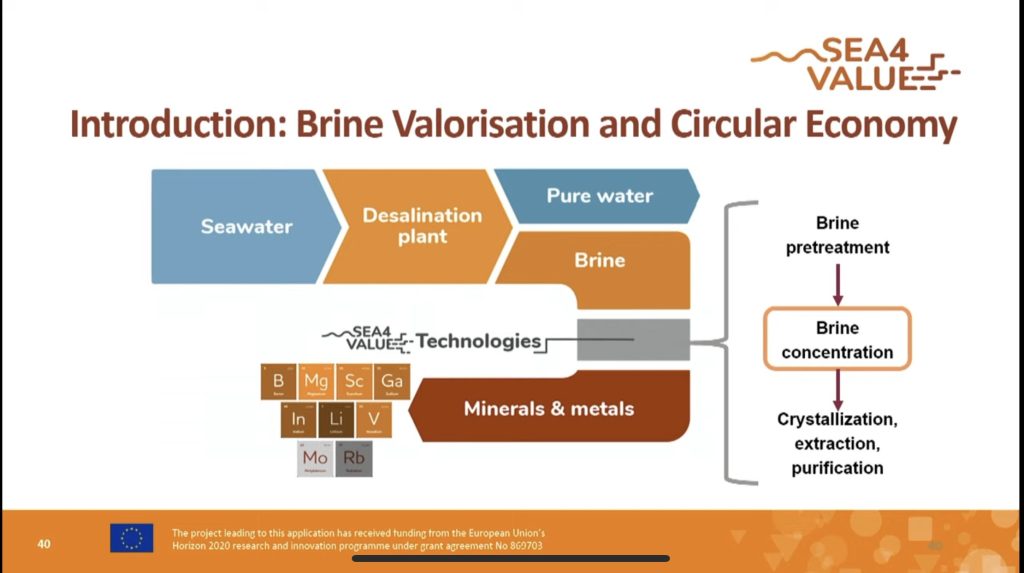
The project, led by the Eurecat technology center, brings together 16 partners from across Europe who firmly believe in science as a tool to redefine our relationship with natural resources. Through a mobile laboratory located in Tenerife, these new technologies have been tested in real conditions, demonstrating that mineral recovery from brine is not only feasible but also beneficial for both the environment and the economy. Recovering elements such as calcium, sodium, magnesium, boron, scandium, vanadium, and indium from brine could transform desalination plants into valuable resource sources, reducing the need for imports and the environmental impact of raw material extraction. For the European Union, this recovery of materials represents an opportunity to strengthen self-sufficiency and supply security, decreasing reliance on third countries.
Moreover, if Sea4Value manages to scale up to an industrial level, its impact would be even more significant. Not only would it enable the recovery of these valuable resources, but it would also help reduce energy consumption and the carbon footprint associated with transportation. By producing the materials necessary for remineralizing desalinated water directly at the desalination plants, transport to production sites could be avoided—a significant advantage for isolated regions like islands, where importing by ship incurs high costs and additional environmental impact.
Sea4Value is part of the European Union’s Horizon 2020 program in terms of project funding. Given its characteristics, this project is an example of how innovation addresses the need to reinvent our production and consumption methods. Desalination plants are no longer merely infrastructures for obtaining potable water; they are being redefined as versatile facilities capable of supplying critical elements for key sectors such as renewable energy and electromobility, where these brine-derived minerals play an essential role.
In summary, the Sea4Value project illustrates perfectly the potential of the blue economy, recognizing seas and oceans as essential sources of wealth for our economy and well-being. By recovering valuable minerals from brine generated by desalination plants, Sea4Value transforms what was once waste into a valuable resource, adding value to seawater beyond its use as potable water. This not only reduces dependence on imported materials but also reinforces the idea that oceans can be engines of sustainable economic development. Sea4Value highlights the seas as sources of sustainable wealth, placing them at the heart of a new resource economy based on respect and environmental responsibility. Additionally, this project has the potential to create new employment opportunities in the technology and industrial sectors, especially in the regions where these innovative technologies are deployed.